
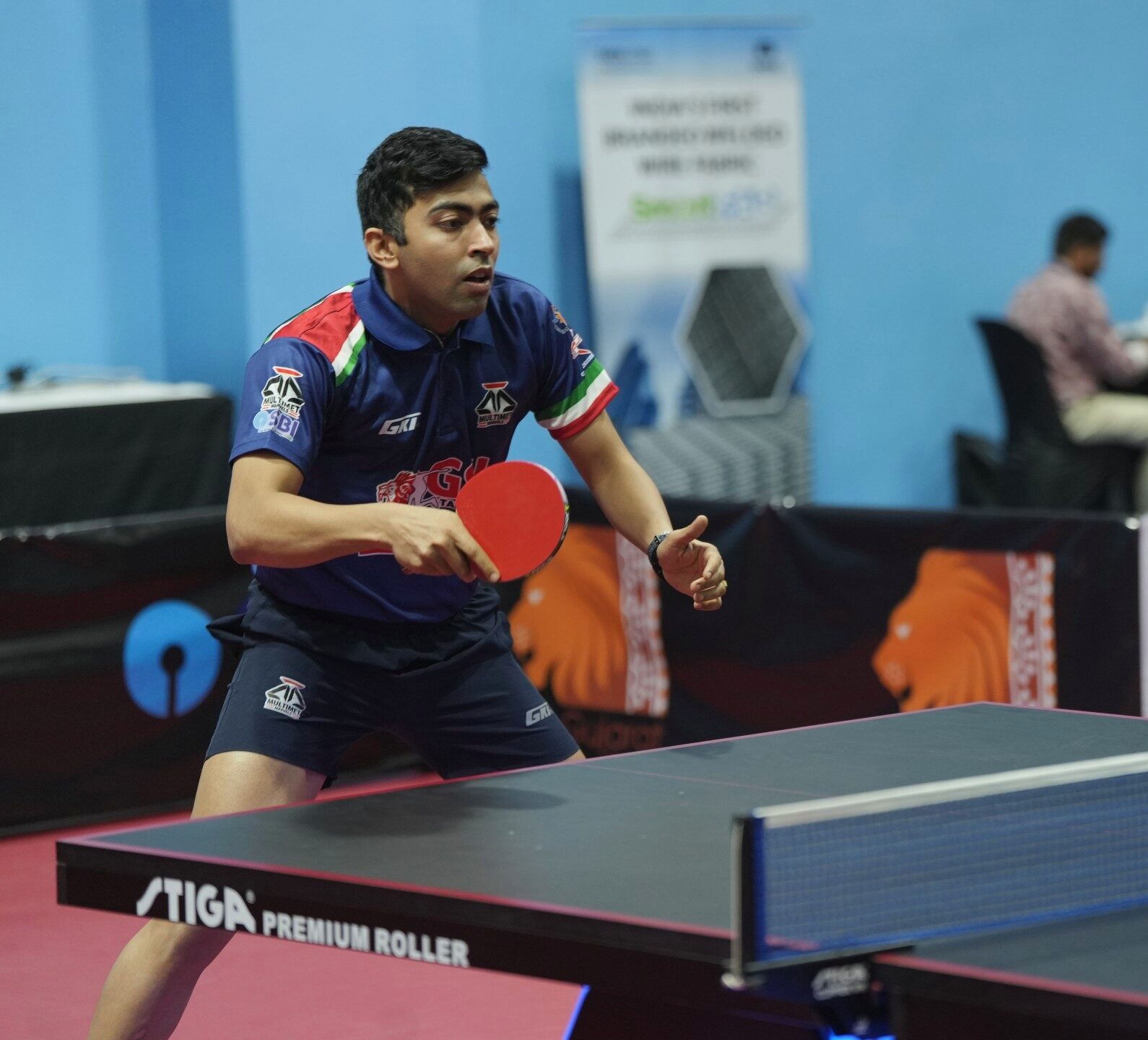
My newborn baby will bring me luck at the Asian Games: Harmeet Desai
Gandhidham, Sept.15: One of India’s leading table tennis players, Arjuna Awardee Harmeet Desai, became a father just days before leaving for Japan to compete in the Asian Games, his fourth consecutive appearance at the continental showpiece. As he prepares for another major challenge, the Surat paddler spoke about his remarkable consistency at the highest level, becoming a father, his preparation, mixed doubles partnership with Yashaswini Ghorpade, India’s medal chances and the role played by the Gujarat government and Gujarat State Table Tennis Association (GSTTA) in his career.
Excerpts:
Q. This will be your fourth Asian Games. After Sharath Kamal, you could be one of the Indian players with the most Asian Games appearances. What is the secret behind your consistency over 16 years at the top level?
A. There are many players who have been consistent, but in my case, I would say it is God’s grace and luck. That has been the biggest factor in my journey. Despite facing so many obstacles, I got the right opportunities at the right time and received tremendous support from many people. I got opportunities to train in different countries and also received support from sponsors. All these factors have helped me remain consistent and continue performing at this level.
Q. The Asian Games will be your first major tournament since you became a father. How has life changed for you? From changing diapers to returning to the table and now leaving your baby and travelling, what are the feelings?
A. This is my first tournament after the baby was born. I am very positive, but at the same time, there is an emotional side because I am leaving my baby when he is hardly 20 days old. I am very happy to begin this new chapter of my life. I am definitely going to miss him while I am at the tournament, but I think he will bring a lot of luck for me.
Q. Let’s talk about your preparation for the Asian Games.
A. I have been training rigorously for six to eight hours a day in my hometown, Surat. I am also in regular consultation with my personal Chinese coach in Germany, who has been guiding me throughout my preparation. Physically and mentally, I am in perfect shape for the Asian Games.
Q. Who do you see as India’s biggest challenge at the Asian Games, apart from China?
A. Ideally, we would not want to face China or Japan in the quarter-finals. If we reach the last eight, we would prefer to play teams like Chinese Taipei or Hong Kong. Relatively, these teams are easier opponents compared to China and Japan.
Q. You have now been paired with Yashaswini Ghorpade in mixed doubles. Tell us about your camaraderie.
A. We have been playing together for the last two years. This year, we reached the finals of both a WTT Star Contender and a WTT Contender. We have also won a WTT Feeder event and, just two or three months ago, we were ranked among the top 12 pairs in the world. We have beaten top players as well, so we are well prepared and will give it our best.
Q. What are the strengths of both players and what allows the two of you to complement each other?
A. Yashaswini has pimples on her backhand and uses them very aggressively. I haven’t seen many players use pimples as effectively as she does. That is her speciality. My attacking game, combined with her defence and strong receiving skills, are the strongest aspects of our combination.
Q. What do you make of India’s medal chances at the Asian Games?
A. Definitely, we have chances. I would say the men’s doubles pair of Manav Thakkar and Manush Shah has a good chance of winning a medal. As far as mixed doubles is concerned, we can consider ourselves as dark horses.
Q. Could you talk about the contribution of the Gujarat State Table Tennis Association and the Government of Gujarat to your success?
A. Many people have helped me reach where I am today. The Government of Gujarat and GSTTA have played a very big role in my journey. The Government of Gujarat, through the Sports Authority of Gujarat, provided me significant financial support under the Shaktidoot scheme. Because of that support, I was able to compete in international tournaments and also receive international-level training.
GSTTA also helped me immensely during my early years. More recently, when its Tapti Valley High-Performance Academy started in Surat with foreign coaches, I was able to train there before the Olympics, and that helped me a lot. GSTTA has been the backbone of my success. It is because of the massive support from the government and the state association, along with our own hard work, that three of the five players in India’s men’s team for the Asian Games are from Gujarat.