
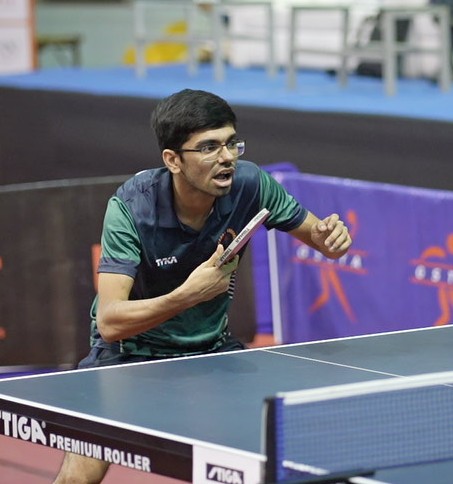
Indian paddlers are no longer just participants, we are medal contenders: Manav Thakkar
Gandhidham, Sept.16: For Manav Thakkar, the upcoming Asian Games will mark a significant milestone. The 26-year-old paddler will make his singles debut at the continental showpiece, having already represented India at two Asian Games and the Paris Olympics. With extensive experience against the world’s best and a growing belief in the strength of Indian table tennis, Thakkar is confident that India can return from the Games with medals across events.
The Gujarat paddler believes the country’s table tennis contingent has undergone a major transformation. From being participants, Indian paddlers are now viewed as genuine medal threats. Thakkar, who will also pair up with Manush Shah in men’s doubles, spoke about his singles debut, India’s medal chances, Gujarat’s emergence as a table tennis powerhouse and the support from GSTTA and the Gujarat government.
Excerpts:
Q. Excited about your third Asian Games?
A. Yes, this will be my third Asian Games and my fourth major multi-sport event overall, including the Olympics. After two Asian Games, this will be my first time playing singles. I knew I would get the opportunity because, after the Paris Olympics in 2024, I became India No. 2, and the top two players get to play singles at the Asian Games.
When I was preparing for the Olympics, playing singles was one of my goals, but unfortunately, I wasn’t good enough at that particular moment. So, I’m really looking forward to playing singles now.
Q. Do you have butterflies in your stomach ahead of your maiden singles appearance?
A. Not really. I have played five of the six WTT Champions tournaments, where the world’s top 32 players get entry. So, I have gained good experience playing against the best players in the world. That experience gives me confidence going into the singles event.
Q. So, you are rating yourself quite highly going into the singles event?
A. Yes. Singles is definitely the most difficult event of all, but I enjoy playing singles because that is what I have done throughout my career. Getting the opportunity to play singles at the Asian Games is one goal achieved, but it’s not just about participating. If we can win another medal, that would be great. India won a medal in 2018, so if we can win one more medal in any event — team, doubles or singles — it would be a great achievement.
Q. What are your medal hopes from the Indian contingent?
A. India is no longer a nation that just participates. Whether it is the men’s or women’s team, singles, doubles or mixed doubles, India is now a strong medal contender.
There has been a huge shift in the perception of Indian table tennis. Other medal contenders now see us as a threat. That is a big change, and it shows how far Indian table tennis has come.
Q. Coming to men’s doubles, you and Manush will be the second seeds at the Asian Games and a strong medal hope for India.
A. Manush and I are currently world No. 3, and being higher seeded at the Asian Games gives us an advantage. We should be able to reach the top four. We don’t necessarily have to beat the highest-ranked pairs in the early rounds. We have to consistently perform well against the lower-ranked pairs and, most importantly, avoid making mistakes against them.
Q. Three players from Gujarat — you, Harmeet and Manush — are now regularly representing India. In fact, three of the five players in the men’s team are from Gujarat.
A. It is definitely a proud moment to see three players from Gujarat representing India. Earlier, I used to see Harmeet as the only player from Gujarat in the Indian team. He also struggled initially to establish himself and had to work very hard.
Slowly, things changed. Then we started coming through, and now three players from Gujarat are part of the Indian team. Manush has also done extremely well in the junior ranks and has now established himself at the senior level. This year, he also won the national championship.
It shows how much Gujarat has developed in table tennis. We want to set a benchmark — not just by being part of the Indian team, but by winning medals and producing results for the country.
Q. How would you describe the support you have received from GSTTA and the Gujarat government?
A. Through GSTTA’s support, I got opportunities to travel abroad for training and tournaments and to work with foreign coaches. I have also been part of the Gujarat government’s Shaktidoot scheme, and it is very encouraging that we will soon see Shaktidoot 2.0.
GSTTA has also taken several important initiatives. They have opened a world-class high-performance academy in Surat with a Chinese coach. The academy is not just for elite players. Many state-level players have also received opportunities for overseas training, competitions and coaching, with their funding and other requirements taken care of.
I think GSTTA is one of the most active associations in India. The kind of support and opportunities being provided are helping Gujarat players develop and compete at the highest level.