
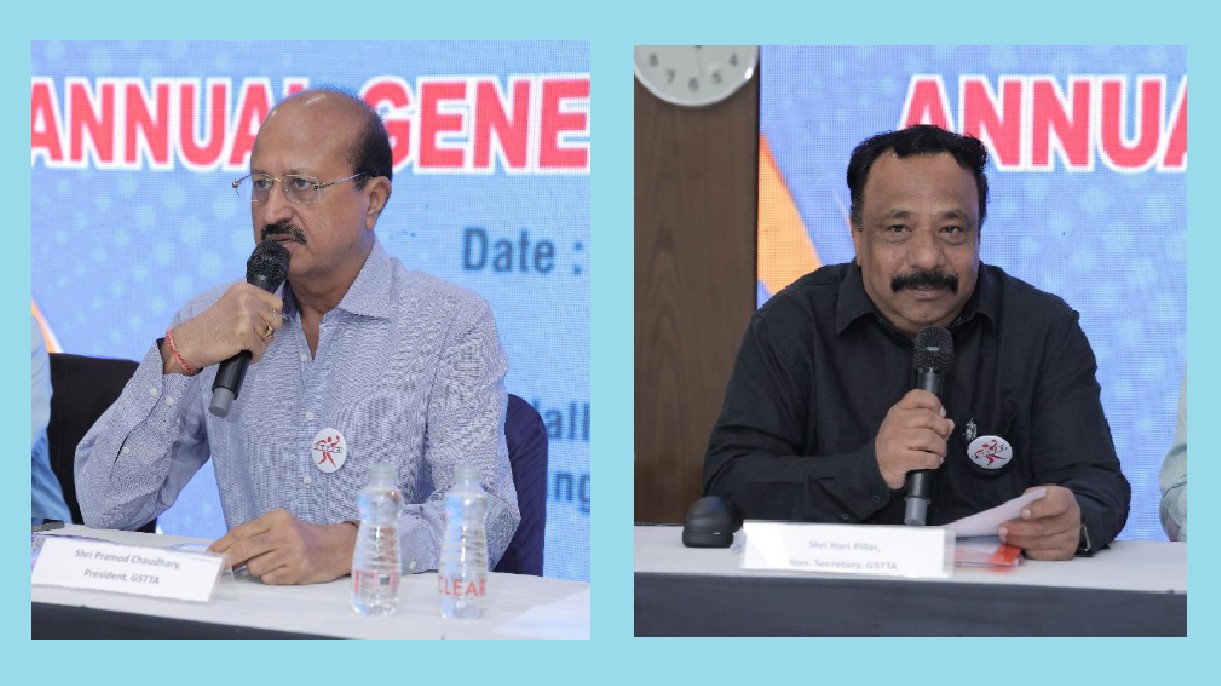
We aim to make Gujarat the hub for table tennis in India: Pramod Chaudhary
Gandhidham, Sept.18: With three of the five Indian men’s table tennis players selected for the Asian Games coming from Gujarat, the state has emerged as one of the country’s prominent centres for the sport. Gujarat State Table Tennis Association (GSTTA) president Pramod Chaudhary and secretary Hari Pillai attribute the rise to sustained grassroots development, increased competition, government support and a conscious effort to take table tennis beyond traditional centres.
Excerpts:
Q. Three of the five Indian men’s team players are from Gujarat. How do you look at this achievement?
A. Having three of the five Indian players from Gujarat is a matter of great honour for GSTTA and the entire table tennis fraternity in the state. It shows that the sport has developed significantly in Gujarat and that good players are emerging from the state.
Q. Manav and Manush reached World No. 2 in men’s doubles. How do you feel about this achievement?
A. It is a very big achievement for both of them and for Gujarat table tennis. Their singles rankings are also improving, which is equally encouraging. Their progress shows that players coming through our system are capable of performing at the highest level.
Q. What kind of work has gone into developing table tennis in Gujarat?
A. The state government is encouraging players through various schemes, awards and training support. The Table Tennis Academy at Tapti Valley in Surat is a good example. It is being run with the support of the Gujarat government, the Sports Authority of Gujarat and Tapti Valley.
At present, 32 players from across Gujarat are training at the academy. Tapti Valley provides them education free of cost, while the government supports coaching, equipments and other requirements. We have Chinese coaches and, earlier, also had two coaches from France.
For these players, accommodation, food, education, coaching and training are provided free of cost. This reflects our commitment to developing the next generation of table tennis players in Gujarat.
Q. What sets GSTTA apart from other state associations?
A. GSTTA conducts various table tennis competitions in the country, including inter-district, state-ranking and national-level events. This gives players regular competitive exposure and valuable match experience.
We also support financially weaker districts. If a district does not have sufficient resources to organise a tournament, the state association helps it conduct competitions. Our objective is to ensure that development is not restricted to a few cities or districts.
Q. Is this the reason GSTTA has been taking tournaments to smaller cities such as Jamnagar and Anand?
A. Yes, we are consciously taking tournaments to Tier-2 cities and smaller centres. We are seeing promising children emerging from places such as Aravalli, which has relatively fewer sporting opportunities.
Our commitment is that no child should be deprived of table tennis because of a lack of resources or facilities.
Q. You have spoken about preparing for the 2036 Olympics. What steps has GSTTA taken towards this goal?
A. Our target is to see Gujarat host the 2036 Olympics and have paddlers from the state become part of the Indian team. Keeping this long-term objective in mind, we introduced the Under-09 category.
We have now started the U-7 category. The idea is for children to start playing table tennis at five or six years of age and enter a competitive environment by the time they are seven or eight.
This ensures that when they travel outside Gujarat for competitions, they are already well prepared.
Q. As GSTTA president, what is the larger dream you are chasing for Gujarat table tennis?
A. We want Gujarat to become the hub for table tennis in India. Certain states have developed strong identities in particular sports. Haryana has become a major centre for boxing, while Uttar Pradesh and Haryana are strong in wrestling. Punjab and the Northeast have traditionally been strong in hockey.
We want Gujarat to build a similar identity in table tennis, an ecosystem where players start young, receive quality coaching, compete regularly and progress to the national and international level.
We have already organised para-table-tennis tournaments and WTT events. The state government has various schemes to support tournaments, while we also receive good support from the sports secretary, the Sports Authority of Gujarat and Hon’ble Sports Minister Shri Harsh Sanghavi. This support is important in taking the sport forward across the state.
Q. Table tennis was omitted from the 2026 Glasgow Commonwealth Games. India potentially lost medal opportunities. What are your expectations for the 2030 edition?
A. I have personally spoken with Hon’ble Sports Minister Shri Harsh Sanghavi, and he has assured me that table tennis will be included in the 2030 Commonwealth Games. Our Honourable Prime Minister has also repeatedly emphasised the promotion of sports and sporting talent.
Our focus is therefore on preparing players well in advance. We want to make a strong impact in table tennis at the 2030 Commonwealth Games as well as at the Olympics.
Q. Shri Hari Pillai, as GSTTA secretary, how much does the association spend annually on the development and promotion of table tennis?
A. Player welfare and development have always been among GSTTA’s foremost priorities. Apart from coaching camps and tournaments, we continuously work to provide better facilities and incentives to players.
GSTTA conducts an annual awards function and introduced cash awards based on players’ performances back in 2021, a practice that continues. We also provide free food, refreshments and juices during tournaments. Prize money is increased every year and, wherever possible, special gifts such as racket covers and rubbers are given to winners.
Considering expenditure on player development, coaching, academies, tournaments, prize money and other initiatives, I estimate that GSTTA spends around ₹10 lakh or more annually directly towards the development and welfare of table tennis in Gujarat.
More importantly, our focus is not merely on spending money but on ensuring that the support reaches players and contributes meaningfully to their development.
Q. How much government support does GSTTA receive every year?
A. The Sports Authority of Gujarat (SAG) has always been very supportive of GSTTA and the development of table tennis. For most State Ranking tournaments, SAG provides stadiums and infrastructure free of cost, which is significant support.
Direct financial assistance is provided according to prevailing SAG norms and depends on the level and nature of the tournament. This includes events such as the State Championships, National Championships and international-level tournaments.
The government’s contribution is therefore not limited to direct financial assistance. Infrastructure and other facilities also play a major role in helping us organise tournaments and promote table tennis across Gujarat.